
Itinerary

Explore the rooms by clicking on the different sections
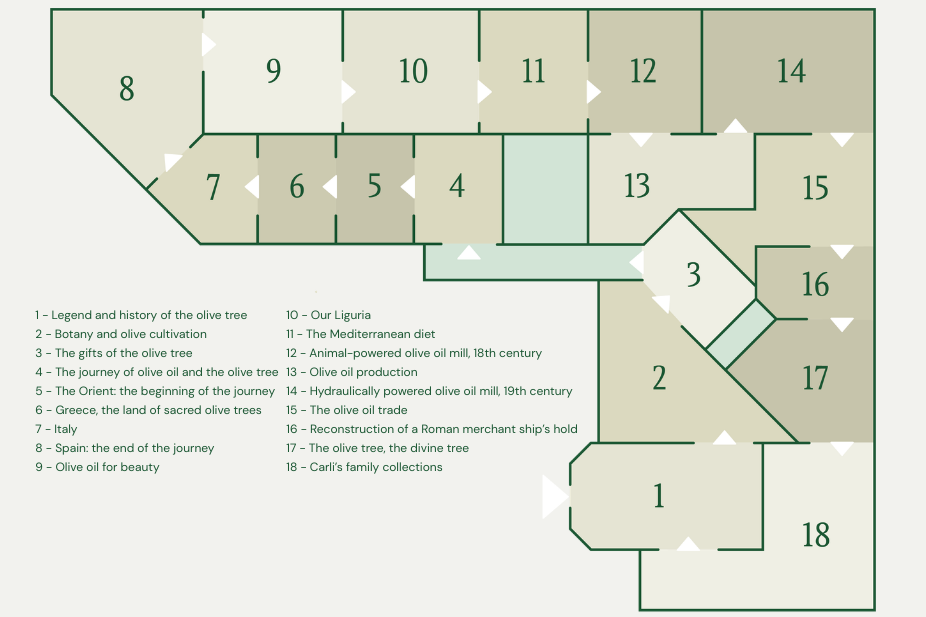
Percorso del museo Sala 1 Sala 2 Sala 3 Sala 4 Sala 5 Sala 6 Sala 7 Sala 8 Sala 9 Sala 10 Sala 11 Sala 12 Sala 13 Sala 14 Sala 15 Sala 16 Sala 17 Sala 18

Eighteen rooms, eighteen stages of a captivating journey into the world of the olive tree.

For over 7,000 years, this noble plant and its precious fruits have been part of human life.

Starting from the olive-growing civilizations of the 4th and 3rd millennia BC, the journey leads to the present day—room by room, unfolding a path that sparks curiosity and wonder in every visitor.

Works of art, rare archaeological finds, and film footage guide you through the most fascinating moments of this remarkable story.

Leggenda e storia dell'olivo

ROOM 1 – LEGEND AND HISTORY OF THE OLIVE TREE

A narrative voice and significant artefacts—including a section of a fossilized trunk from a 12-million-year-old wild olive tree—open the doors and guide you on a journey to discover the remarkable events that, for over 7,000 years, have linked humankind with the olive tree and its oil throughout the Mediterranean area.

Botanica e olivicoltura

ROOM 2 – BOTANY AND OLIVE CULTIVATION

This section illustrates some of the botanical characteristics of this plant, within a setting dominated by a suspended olive grove that enhances the display of ancient agricultural tools used by farmers in the past.

I doni dell'olivo

ROOM 3 – THE GIFTS OF THE OLIVE TREE

Light, cosmetics, seasoning, warmth, and much more: all are gifts of the olive tree and its fruits.

In this room, a selection of objects is displayed. These are items that humankind has developed over time to make the best use of this precious plant. Unguentaria, lamps, braziers, containers for medicinal oils… here we display gifts that were discovered, forgotten, and then rediscovered through the different eras and places.

In the image: Black-glazed guttus, Southern Italy, 400–200 BC.

Il viaggio dell'olio e dell'olivo

ROOM 4 – THE JOURNEY OF OLIVE OIL AND THE OLIVE TREE

In ancient times, oil was transported in amphorae or stored in precious small vessels.

First Eastern seafarers, and later the Phoenicians, Mycenaeans and Greeks traded in olive oil and perfumed ointments.

Through these contacts, the coastal populations of antiquity discovered the remarkable properties of olive oil and learned the techniques of olive cultivation.

“The Mediterranean ends where the olive trees end.”

Oriente: l'inizio del viaggio

ROOM 5 – THE ORIENT: THE BEGINNING OF THE JOURNEY

Oil began its journey in Tyre in Phoenicia, under the protection of the god Melqart, later identified with Heracles.

Aboard ships, it passed through the Strait of Gibraltar, and in Cádiz, an olive tree made of emeralds, placed in another temple of Melqart, marked the point of arrival and the end of the Mediterranean.

In this room, you can admire precious stone and glass vessels that ensured the preservation of olive oil during these long journeys.

La Grecia, terra degli olivi sacri

ROOM 6 – GREECE, THE LAND OF SACRED OLIVE TREES

In Classical Athens, the olive tree was held in exceptional regard: the tree planted on the Acropolis of the goddess Athena was the symbol of the city, embodying its survival and prosperity.

The olive tree reached Greece in very ancient times: the many artefacts on display and the scenes depicted testify to how present and important olive oil was in every aspect of life in ancient Greece.

L'Italia

ROOM 7 - ITALY

The olive tree made its first, tentative appearance in Italy around 3,500 years ago and spread through Phoenician and Carthaginian traders, as well as Greek colonists, particularly from the 7th century BC onwards.

In the Italic cities of Magna Graecia, olive oil was essential for food, cosmetics, rituals, lighting, and body care. The Etruscans and Italic peoples soon established olive groves and produced olive oil, giving rise to an increasingly important internal trade.

Spagna: la fine del viaggio

ROOM 8 – SPAIN: THE END OF THE JOURNEY

The olive tree and its precious fruits reached the Mediterranean and Atlantic coasts of the Iberian Peninsula in the 8th century BC through Phoenician traders.

Ceramics, ivory, jewellery, perfumes and other luxury goods coming from the East were used to obtain the metals Spain was rich in: copper, silver and gold.

Fragments of oil amphorae, used to transport oil from the Iberian Peninsula and Andalusia, were used to build an artificial hill in Rome, known as “Monte Testaccio.”

It stands as a unique monument in the world and as an extraordinary historical archive, as well as as a sign of the  importance of olive oil trade in ancient Rome.

Olio per la bellezza

ROOM 9 – OLIVE OIL FOR BEAUTY

Since the earliest days of history, perfumed oils and ointments prepared for body care often played a prominent role.

In this room, you will find examples of the countless vessels for cosmetic oils that accompanied the development of Mediterranean civilizations: they still seem to retain a trace of the beauty of those for whom they were created.

Olive oil, moreover, appears in many of the oldest recipes for cosmetics and ointments designed to enhance and preserve beauty.

La nostra Liguria

ROOM 10 – OUR LIGURIA

From the Ligurian Alps, valleys descend steeply towards the sea: to use the little land available, a monumental effort of terracing was required, building walls to retain the scarce soil and make it cultivable.

Stone by stone, terrace by terrace, our Liguria was created. It was our ancestors who built the dry-stone walls of Western Liguria over the centuries, from the sea all the way up into the mountains.

In this same room, you can also see some olive oil cans which, from the second half of the 19th century, carried our oil from the Riviera across the seas to the rest of the world.

It was packaged in lithographed cans, very colorful and often imaginative in their branding and decoration.

La dieta mediterranea

ROOM 11 – THE MEDITERRANEAN DIET

A film illustrates the Mediterranean diet, discovered by science in the 1950s, yet rooted in traditions that date back thousands of years.

A food pyramid in which olive oil plays an essential role.

On 16 November 2010, the Mediterranean diet was inscribed on the list of the Intangible Cultural Heritage of Humanity.

Frantoio a trazione animale

ROOM 12 – ANIMAL-POWERED OLIVE OIL MILL, 18th CENTURY

This type of mill was the most widespread in our territories, as it was powered by animal force and could therefore be installed anywhere, even in house cellars.

For this reason, it is also known as “a bestia” or “a sangue.”

It consists of a millstone and a press made of stone and wood.

Produzione olio

ROOM 13 – OLIVE OIL PRODUCTION

To obtain olive oil, the first essential step was crushing the olives, followed by pressing.

Here, a range of machines made of wood, stone, and metal is displayed, all necessary for processing the olives.

Once the oil had been obtained, it needed to be measured: in the Middle Ages and the modern period, each town had officials responsible for preserving and supervising official measures.

In Oneglia they were known as Rasperii, and in Porto Maurizio as Ministralis. In this room, several examples of weights and measures can be seen.

In the image: marble measure equivalent to a quarter of an oil barrel

Frantoio a trazione idraulica

ROOM 14 – HYDRAULICALLY POWERED OLIVE OIL MILL, 19th CENTURY

Hydraulic mills were built in locations where watercourses could be channelled, often along streams and rivers.

They processed larger quantities of olives and operated more continuously.

Here, two mills connected by a system of gears are on display, along with a double press.


Il commercio oleario

ROOM 15 – THE OLIVE OIL TRADE

In the best years, the mills of the Riviera Ligure di Ponente produced over 400,000 barrels of oil, equivalent to more than 250,000 quintals.

The oil had to be stored under optimal conditions, both for local consumption and for export.

Jars were the most widely used containers: they stored household oil supplies but were also used in warehouses and mills.

Stiva di una nave romana

ROOM 16 – RECONSTRUCTION OF A ROMAN MERCHANT SHIP’S HOLD

In Roman times, olive oil was one of the most essential products of daily life: large urban centres, Rome in particular, were supplied by vast fleets sailing from oil-producing provinces to the various ports of the Empire.

Here you can see a faithful reconstruction of the hold of a Roman merchant ship, with its cargo of amphorae—the transport container par excellence.

Their distinctive shape allowed them to be stacked in overlapping rows, making them especially suitable for maritime transport.

Pace e sacralità

ROOM 17 -THE OLIVE TREE, THE DIVINE TREE

The olive tree is the quintessential symbol of the Mediterranean. Its branches represent peace, honour and victory, offering protection to supplicants and envoys.

Its oil, blended with balm, anoints kings, prophets, priests and bishops. In the ancient East, in the religions of the classical world, and within the Christian, Jewish and Muslim traditions, the olive tree and its oil form a bridge between the human and the divine.

Collezione della famiglia Carli

ROOM 18 - CARLI'S FAMILY COLLECTIONS

From the ancient world, throughout the centuries of the Middle Ages and into the modern era, the history of humankind and that of the olive tree have been intertwined across the Mediterranean.

Two objects can be seen as symbols of this story: oil lamps and cruet sets. From the collection of these items we get a picture able to assemble history, uses, cultivation and processing techniques, trades, rituals, poetry and works of art, which you can admire here as the perfect conclusion of this journey into the world of olive oil.

The Museum
The Treasures
Your experiences at the Museum

The Museo dell'Olivo Carlo Carli

Address:
via Garessio 13 - 18100 Imperia - Italy

Phone:
+39 0183 295762

Email:
info@museodellolivo.com

Opening hours:
Monday: closed
From Tuesday to Saturday: 10:00–13:00 / 15:00–18:00
Sunday: closed
LAST ADMISSION 45 MINUTES BEFORE CLOSING TIME

Closing days:
01/01/26 – 06/01/26 – 05/04/26 – 06/04/26 – 01/05/26 – 15/08/26 – 01/11/26 – from 16/11 to 25/12/26 (maintenance) – 31/12/26

Open on:
25/04/26 – 02/06/26

A large free parking area for coaches and cars is available within the complex.